


Specialist care
Pelvic ultrasound in Slavuta
During a pelvic ultrasound, the doctor examines your uterus, endometrium, cervix, ovaries and adnexa. At Viva Clinic in Slavuta, the scan is done at the polyclinic at 27a Sobornosti St, either through the abdomen or transvaginally. You can book by phone or on Viber.
Paid serviceBy appointment
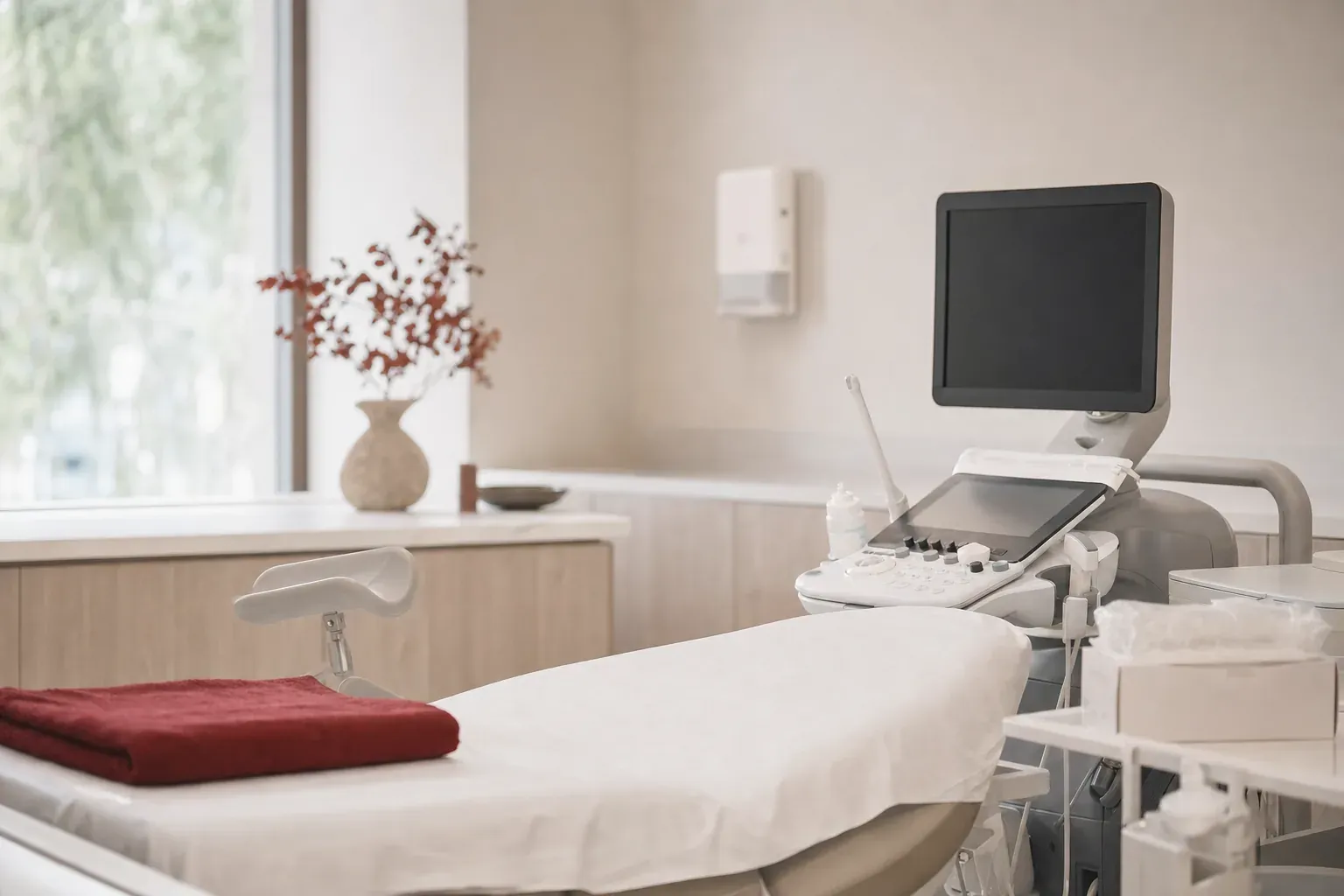
At a glance
- Where
- 27a Sobornosti St, Slavuta
- Hours
- Mon–Fri 8:00–17:00
- How to book
- phone or Viber
- Payment
- paid
When you may need a pelvic ultrasound
- Cycles shorter than 24 or longer than 38 days, or irregular, heavy or painful periods
- Spotting between periods or after sex
- Lower abdominal pain that keeps coming back
- Planning a pregnancy or having trouble getting pregnant
- Any bleeding after menopause, even light spotting
- Fibroids, an ovarian cyst or other changes that need monitoring
- Checking the position of an IUD
- Your gynecologist recommended an ultrasound at a routine checkup
What a pelvic ultrasound includes
- Ultrasound through the abdomen (transabdominal)
- Transvaginal ultrasound
- Examination of the uterus, endometrium and cervix
- Examination of the ovaries and adnexa
- Gynecologist consultation to go over the results
- Swabs and lab tests at Diagnost-Lab, as ordered by your doctor
- Colposcopy, if your gynecologist orders it
How to prepare for a pelvic ultrasound
Preparation depends on how the scan is done. For an abdominal scan your bladder needs to be full: it pushes the bowel loops aside and gives the doctor a clear view of the uterus and ovaries. Usually you drink 0.5–1 l of still water 30–60 minutes before the scan and don’t go to the toilet until it’s done. Before a transvaginal scan you empty your bladder instead. We’ll explain how to prepare for your particular scan when you book.
A routine scan is usually done in the first half of the cycle, a few days after your period ends. The endometrium is thinner then, and changes in it are easier to see. For some purposes your gynecologist will choose a different day, so ask them in advance. After menopause the day doesn’t matter. Remember the date your last period started and bring reports from previous ultrasounds. To learn how to count your cycle and which periods count as too heavy, read our article on how long periods last.
If you might be pregnant, mention it when you book. In early pregnancy a separate pregnancy ultrasound is done.
What happens during the scan
For an abdominal scan you lie on your back, and the doctor puts gel on your lower abdomen and moves the probe over it. For a transvaginal scan you take off your underwear and lie on your back with your knees bent. The doctor inserts a slim probe into the vagina. It feels similar to a pelvic exam, though usually easier. If both are planned, the abdominal scan comes first, then you empty your bladder and the doctor continues transvaginally. The scan usually takes up to half an hour. Afterwards you can get on with your day straight away.
If you haven’t been sexually active, tell the doctor before the scan, and you’ll have an abdominal ultrasound instead.
What the scan shows and what comes next
The doctor assesses the size and structure of the uterus, the thickness of the endometrium, and the ovaries and the follicles in them. Ultrasound shows fibroids, polyps, ovarian cysts, free fluid in the pelvis and the position of an IUD. The endometrium changes in thickness over the cycle, so the doctor assesses it in light of your cycle day. Small cysts that form in the ovary during the cycle often go away on their own, and the doctor may suggest repeating the scan after your next period. After menopause the gynecologist looks first of all at the thickness of the endometrium, especially if there’s been any bleeding. The surface of the cervix is examined in detail during a colposcopy, which your gynecologist orders separately.
Discuss the report with a Viva Clinic gynecologist. They see patients at 27a Sobornosti St or 3 Danyla Halytskoho St, and the exact address is confirmed when you book. Swabs and lab tests are analyzed by the Diagnost-Lab laboratory at 32 Sobornosti St. The ultrasound is paid. For men, the pelvic organs are checked with a prostate and scrotal ultrasound. The polyclinic also offers other ultrasounds and diagnostic tests, so you don’t need to travel to Khmelnytskyi or Kyiv.
When not to wait for a routine scan
Call an ambulance (103) if you suddenly get severe pain in your lower abdomen, especially if your period is late or a pregnancy test is positive, or if you’re bleeding very heavily and feel dizzy. If you have lower abdominal pain with a fever or unusual discharge, see a doctor the same day.
Questions about pelvic ultrasound
Which day of my cycle should I have a pelvic ultrasound?
A routine scan is usually done in the first half of the cycle, a few days after your period ends, when the endometrium is easiest to assess. For some purposes your gynecologist will choose another day, so check with them. After menopause, or if you have pain or bleeding, the scan can be done on any day.
How is a transvaginal ultrasound different from an abdominal one?
In a transvaginal ultrasound, a slim probe is placed in the vagina, which gives the doctor a clearer view of the uterus, endometrium and ovaries. You empty your bladder first. An abdominal scan is done with a full bladder, and it's the option used if you haven't been sexually active.
Does a transvaginal ultrasound hurt?
Usually not. The probe is slim, and the scan is usually easier to tolerate than a manual pelvic exam. It can be unpleasant if your lower abdomen is already sore. If you feel uncomfortable or anxious, tell the doctor before or during the scan.
Can I have a pelvic ultrasound during my period?
Yes, if you have pain or heavy bleeding. A routine scan is better moved to the days after your period, when the doctor can assess the endometrium and the inside of the uterus more easily. If you're not sure whether your cycle day is right, ask when you book.
How much water should I drink before an abdominal pelvic scan?
Usually 0.5–1 l of still water 30–60 minutes before the scan, and don't go to the toilet until it's done. A full bladder pushes the bowel loops aside and gives the doctor a better view of the uterus and ovaries. If a transvaginal scan follows, you empty your bladder before it.
Articles: pelvic ultrasound

How long periods last and what counts as a normal menstrual cycle
A period usually lasts 2 to 7 days. For adult women, doctors consider a cycle of about 24 to 38 days normal, counting from the first day of one period to the first day of the next. If bleeding lasts longer than a week, your periods are very heavy, you bleed between them or your cycle suddenly changes, see a gynecologist.
When to have a breast ultrasound and on which day of your cycle
A routine breast ultrasound is usually done in the first half of your cycle, roughly between days 5 and 12 counting from the start of your period, when your breasts are least swollen. After menopause, any day is fine. If you've noticed a lump or nipple discharge, don't wait for the right day and book an appointment with a mammologist, a breast specialist, straight away.

Laser treatment for varicose veins: preparation, procedure and recovery
Laser treatment for varicose veins, or endovenous laser ablation (EVLA), closes the affected vein from the inside through a small puncture, with no incisions. It is done on an outpatient basis, and a vascular surgeon decides whether it suits you after an exam and a vein ultrasound. After EVLA you usually go home the same day, and the doctor tells you what activity level and compression stockings you need.

What kidney pain feels like and how to tell it from back pain
Kidney pain is felt in the side of your lower back, just under the lowest ribs, usually on one side. It is dull and aching or comes in waves, as with renal colic, hardly changes when you move and often comes with a fever or changes in your urine. Back pain usually gets worse when you bend, twist or sit for a long time and eases when you rest.

Ligament sprain: what to do and when to see a trauma doctor
In a sprain, some of the fibers in a ligament tear, so the joint hurts and swells, a bruise appears and moving it is painful. For the first 48 hours, rest the joint, apply cold through a cloth, wrap it in a moderately firm bandage and keep your leg raised. If you cannot stand on your leg or the joint looks deformed, go to a trauma unit (travmpunkt), where they will take an X-ray straight away. If the pain does not ease within a few days, see a trauma doctor to rule out a fracture or a torn ligament.
Colonoscopy: what it is, how to prepare and whether it hurts
During a colonoscopy, a doctor examines the inside of the large intestine with a thin, flexible tube that has a camera on the end. So that the doctor can see the whole lining, the bowel is cleared in advance: a few days before, you switch to low-fiber food, and the day before, you drink a bowel prep solution as your doctor instructs. Without anesthesia the test can be unpleasant, so you can have it under anesthesia.

How to prepare for an abdominal ultrasound
Come to an abdominal ultrasound on an empty stomach, usually after 6–8 hours without food, which is why the scan is easiest to schedule in the morning. You can drink a little plain water. If you often get bloated, cut out the foods that make it worse for 1–2 days before the scan.

Thyroid gland: symptoms, tests and when to have an ultrasound
The thyroid gland sits at the front of the neck, under the Adam's apple, and makes hormones that control metabolism, heart rate and body temperature. When it is underactive, people feel cold, tire quickly and gain weight; when it is overactive, they have a racing heart, sweating, weight loss and shaking hands. Testing usually starts with a TSH blood test, and the doctor adds free T4, antibodies or an ultrasound if needed.
More in ultrasound and diagnostics
 Abdominal ultrasound
- Kidney and bladder ultrasound
- Thyroid ultrasound
- Breast ultrasound
- Pregnancy ultrasound
- Echocardiography (heart ultrasound)
- Leg vein and artery ultrasound
- Prostate and scrotal ultrasound
- Joint and soft tissue ultrasound
- Neurosonography (infant brain ultrasound)
- ECG
- Holter and 24-hour blood pressure monitoring
- Spirometry
- Gastroscopy (upper endoscopy)
- Colonoscopy
- Sigmoidoscopy (rectoscopy)
Where to get a pelvic ultrasound in Slavuta
Google rating and reviews
Viva Clinic ratings on Google Maps and recent patient reviews. If you have visited us, please leave a review.
Polyclinic
27a Sobornosti St, Slavuta
4.443 reviews
Message or call us
Our administrators will help you choose a doctor and a convenient time.