
Cough in children: what to do and when to see a doctor
Most coughs in children come with a cold and usually clear up on their own within 3 to 4 weeks. Drinks, fresh humid air and rinsing the nose help, and the only cough medicine to give is one your pediatrician has recommended, at the dose for your child's age from the leaflet. If your child is struggling to breathe or breathing noisily, their lips turn blue, or they have choked on something and are struggling to breathe, call an ambulance on 103.
Published Updated 6 min read
Coughing clears mucus and germs from the airways, so there is usually no need to suppress it completely. The doctor looks for what is causing the cough. Once the cold or other cause passes, the cough gradually goes away.
Types of cough in children and their causes
A dry cough without phlegm is common at the start of a cold, with an irritated throat or with allergies. A wet cough appears when mucus builds up in the airways. Young children usually swallow the mucus, so you may not see any phlegm.
A night-time cough is often linked to a runny nose: when your child lies down, mucus runs down the back of the throat and irritates it. A cough at night or early in the morning, after running or in the cold, especially with a whistling sound in the chest, can be a sign of asthma and should be checked by a doctor.
Other common causes:
- allergy: a cough without a fever, with sneezing and watery eyes, in a certain season or after contact with an animal or dust;
- whooping cough: bouts of coughing one after another, after which the child breathes in with a whoop, turns red and sometimes vomits; whooping cough is especially dangerous for babies;
- a foreign object: the cough starts suddenly, while eating or playing with small parts;
- tobacco smoke: children around people who smoke cough more often.
Barking cough in a child: what to do
A harsh cough that sounds like barking, with a hoarse voice and noisy breathing in, is most often caused by croup. Croup is a viral inflammation of the larynx and windpipe that narrows the airways. It is more common in young children and usually gets worse at night.
Sit your child upright, hold them and calm them down, because crying makes breathing harder. Give them something to drink. Do not hold your child over a pot of hot water: steam does not help croup and can scald.
With a barking cough, have a doctor see your child the same day, even if they are breathing freely. For croup, the doctor may prescribe medicine that reduces swelling in the larynx. If your child is breathing noisily even at rest, the skin between the ribs is sucked in, the lips turn blue, or they cannot swallow and are drooling, call 103.
How to ease a cough at home
- Offer drinks more often: warm drinks soothe the throat.
- Air the room and do not let it get too hot. Hot, dry air irritates the airways, so a humidifier can help during the heating season, as long as you clean it regularly.
- Rinse a blocked nose with a saline nasal solution so that less mucus drips into the throat.
- Children over one year old can have a spoonful of honey before bed if they are not allergic to it. Do not give honey to babies under one.
- Do not smoke at home or around your child.
Children should only get the cough medicines your pediatrician has recommended, at the dose for their age from the leaflet. Syrups work in different ways: some suppress the cough, others thin the mucus. They are not prescribed together, because a suppressed cough cannot clear the thinned mucus. Antibiotics do not work against viruses and are not needed for an ordinary cold.
Do not use mustard plasters or cupping on a child: there is no evidence that they help, and they can cause burns.
When to see a doctor urgently
Call an ambulance on 103 if your child:
- is breathing with difficulty, fast or noisily, or the skin between the ribs or above the breastbone is sucked in;
- has blue or gray lips, tongue or skin around the mouth;
- has choked while eating or playing and is struggling to breathe, unable to talk or cry;
- stops breathing or turns blue during a coughing fit;
- is very floppy or drowsy and not responding to you as usual.
See a doctor the same day if:
- the cough is barking and the voice is hoarse;
- the cough comes with a high temperature, especially one that has lasted more than three days;
- a baby under 3 months has a cough (if they also have a temperature of 38 °C or higher, call 103);
- the cough comes in fits, after which your child struggles to breathe in or vomits;
- you can hear wheezing in the chest, or breathing hurts;
- the cough started after your child choked on something, even if the coughing fit has passed.
A cough that lasts more than three weeks, or comes back every night or after every run, also needs a doctor’s check, though not urgently. Book an appointment with the pediatrician in the next few days.
How a pediatrician examines a child with a cough
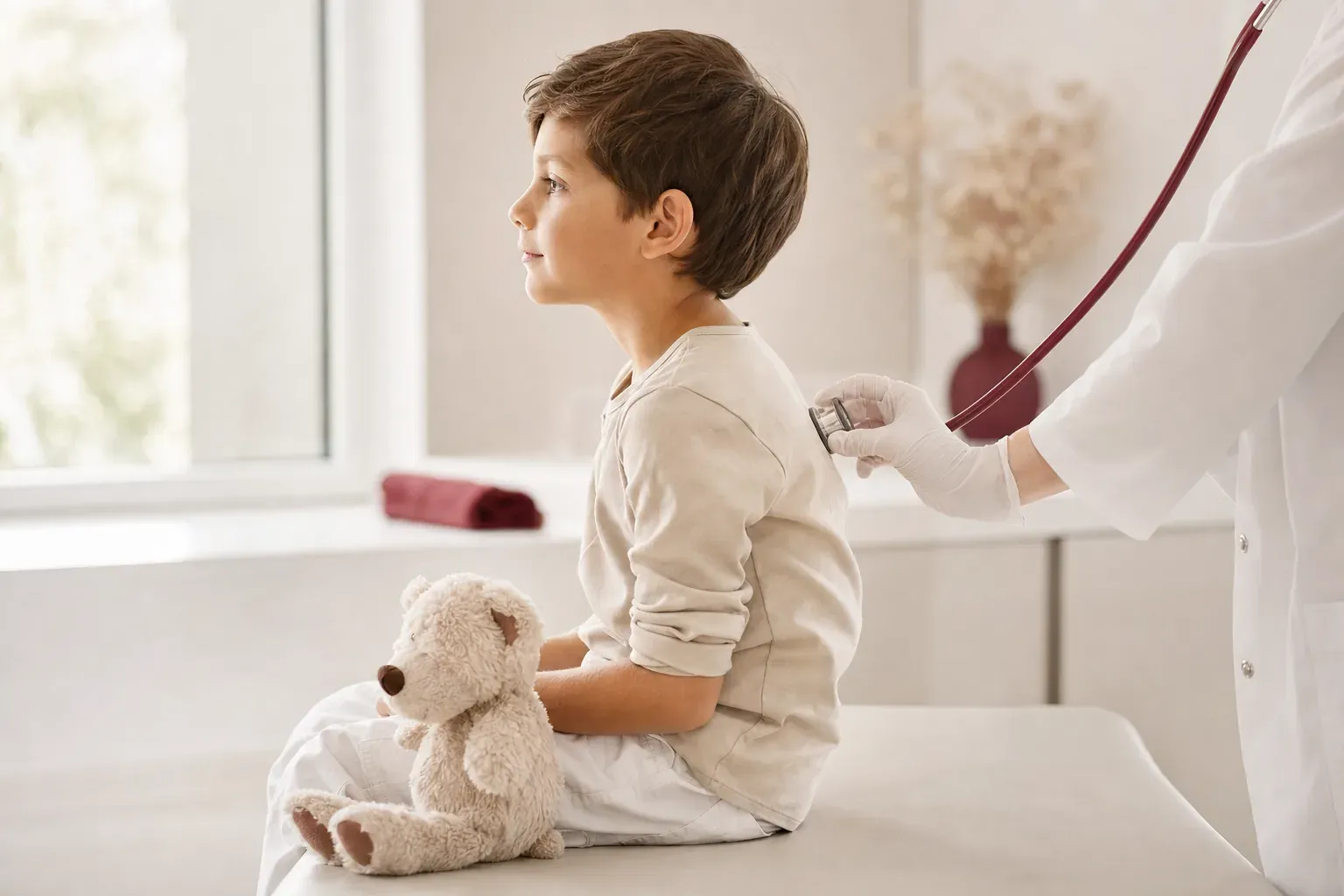
The doctor asks when the cough started, what it is like and when it gets worse, whether there has been a temperature and whether anyone at home is ill. Then the doctor examines the throat and nose, listens to the lungs from the front and back, and counts how fast your child is breathing.
If needed, the pediatrician will give you a referral for lab tests or other tests. Lab tests can be done at the Diagnost-Lab laboratory at 32 Sobornosti St (4th floor), and the Viva Clinic polyclinic at 27a Sobornosti St does lung ultrasounds for children. If the cough is linked to a constantly blocked nose, snoring or adenoids, the pediatrician may refer your child to an ENT doctor, who also sees children.
A Viva Clinic pediatrician in Slavuta sees children from birth to 18 at 27a Sobornosti St or 3 Danyla Halytskoho St (the exact address is confirmed when you book) and can examine your child at home. You can book by phone or on Viber. If the cough comes with a temperature, also read how to help a child with a fever before the doctor arrives.
Questions and answers
Can I take my child outside when they have a cough?
Yes, if your child has no fever and feels well. A calm walk in the fresh air does no harm, while running and active games in frosty weather can make the cough worse. While your child is ill, walk where there are fewer other children so you do not spread the infection.
Should my child have nebulizer treatments for a cough?
Only if a doctor has prescribed them. A nebulizer delivers medicines that are needed, for example, for wheezing or asthma, and the doctor sets the dose. Do not put oils, herbal infusions or medicines not meant for inhalation into a nebulizer: they irritate the airways.
Is a child's cough contagious?
It depends on the cause. A cough from a cold, flu or whooping cough spreads to others, so keep a sick child at home and teach them to cough into their elbow or a tissue. A cough from allergy or asthma is not contagious, but a doctor should still see a child who has it.
Can I give my toddler a cough syrup that helped an older child?
No. Coughs in children have different causes, and many syrups have age limits, so a medicine that suited an older brother or sister can harm a younger child. Whether a medicine is needed at all, and which one, is for the pediatrician to decide after an examination.