
Men's cosmetology: what men see a cosmetologist for
Men's skin is usually thicker and oilier than women's, and daily shaving adds irritation and ingrown hairs. Men most often see a cosmetologist for facial and back cleansing, chemical peels, facial or scalp mesotherapy, botulinum toxin injections for expression lines or sweating, and papilloma removal. At Viva Clinic in Slavuta, treatments are chosen after a skin assessment, and injections are done only by cosmetic doctors after a consultation.

Published Updated 6 min read
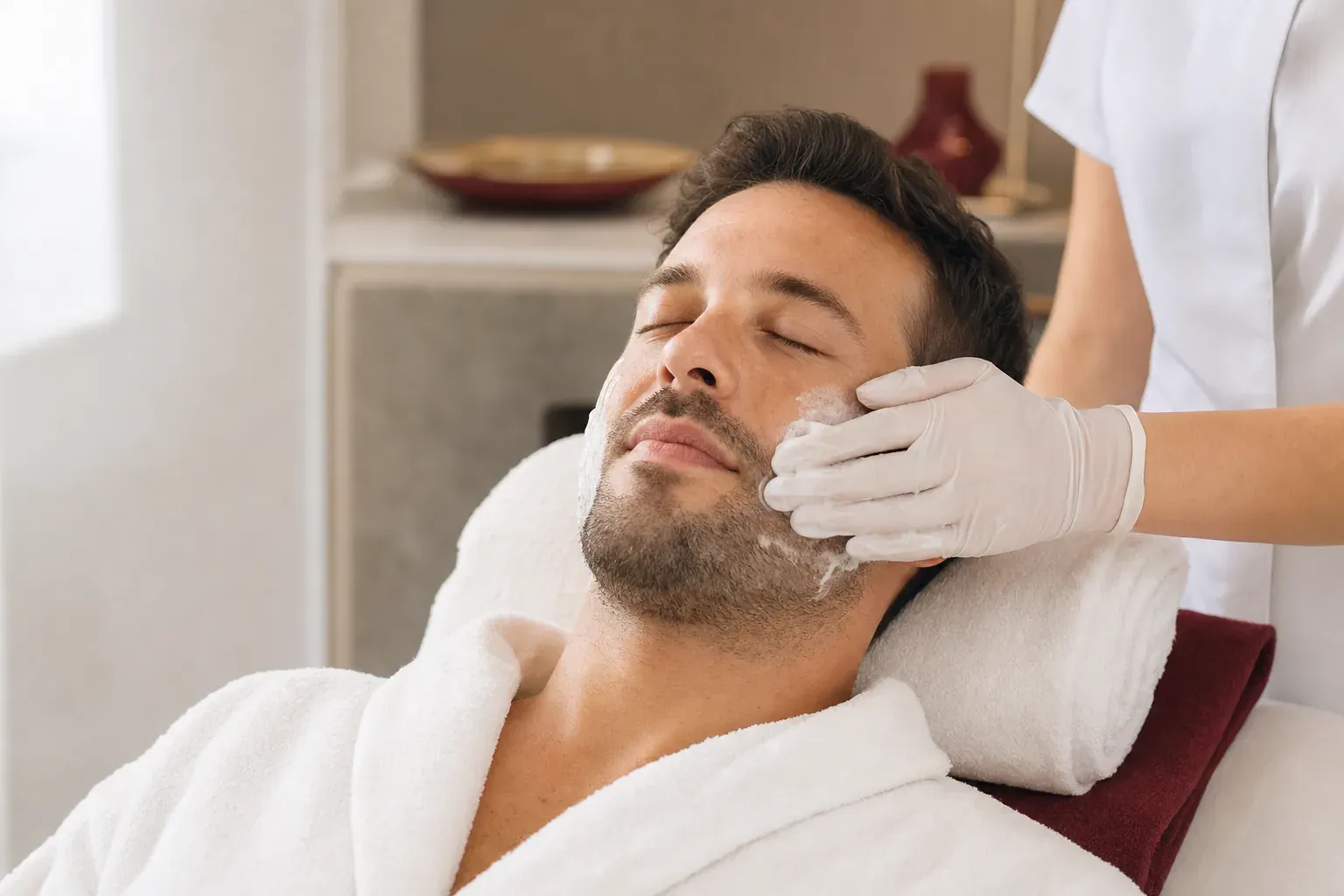
How men’s skin differs from women’s
Under the influence of male hormones, men’s skin is thicker and denser, and the sebaceous glands are more active. That’s why many men have oilier skin, more visible pores and more blackheads on the nose, forehead and cheekbones. Men usually sweat more, too.
Daily shaving leaves its mark as well. Along with the stubble, the blade removes part of the top layer of skin, which leads to irritation and small cuts on the cheeks and neck. Hairs often grow in after shaving in the beard area.
Skincare follows the same rules as for women: cleansing, moisturizing and sun protection. The cosmetologist also chooses treatments based on the condition of your skin.
What men see a cosmetologist for
Men most often come to a cosmetologist for men at Viva Clinic with the following:
- blackheads, enlarged pores, oily shine and breakouts on the face or back, which are treated with facial and back cleansing and chemical peels;
- a vertical frown line between the brows or forehead lines, which are corrected with botulinum toxin injections;
- sweaty palms, feet or forehead that antiperspirants can’t control, which are also treated with botulinum toxin injections;
- thinning hair, for which the doctor may suggest scalp mesotherapy once the cause is known;
- papillomas on the face or body, which are removed after a doctor’s examination;
- ingrown hairs after shaving.
Why hairs grow in, how to shave so it happens less often and when to see a doctor about it is explained in our article on ingrown hairs.
Which facial cleansing suits men
The type of cleansing is chosen after an examination, just as for women, based on how oily your skin is, any breakouts and sensitivity. Manual facial cleansing is usually recommended for oily skin with clogged pores and blackheads, because it cleans the deepest. The whole face takes about an hour and a half on average, the T-zone alone about 40 minutes. If there are many inflamed spots, manual cleansing is postponed or a gentler type is chosen, such as ultrasonic or non-traumatic cleansing.
Manual cleansing is usually done no more than once a month. Your skin stays red for a while afterwards, so don’t schedule it right before an important meeting. When you book, ask whether to shave on the day of the treatment, because products can sting more on freshly shaved skin.
You can’t clean your own back properly, so it’s done as part of body treatments, with special peeling products. Chemical peels are recommended for uneven texture, clogged pores and oiliness, and a cosmetic doctor chooses them. Tell the doctor if you take isotretinoin for acne or finished a course less than six months ago: a medium-depth peel usually isn’t done in that case.
Botulinum toxin and mesotherapy: what men should know
Men have botulinum toxin injections for expression lines on the forehead and the bridge of the nose. They often ask to get rid of the vertical frown line between the brows, which makes the face look stern, and to keep the brows straight. Men’s facial muscles are usually stronger, so the dose may be higher than for women. The first changes appear in 2–3 days and the full effect in about 2 weeks. For wrinkles, it usually lasts 3–4 months, and longer for sweating. If you sweat all over your body or mostly at night, lose weight for no reason, or have a fever or a racing heart, see an internist or a family doctor first.
Scalp mesotherapy is done when hair is thinning, but the doctor first finds out why. In men it’s often hereditary hair loss, but it can also be iron deficiency or thyroid disease. Whether the treatment makes sense depends on the cause.
Injections are done only by cosmetic doctors and only after a consultation. They aren’t done if there’s inflammation or infection of the skin in the injection area or an allergy to any component of the product. Botulinum toxin also isn’t used with myasthenia gravis or other neuromuscular junction disorders, and mesotherapy is postponed during an acute infection or fever. Tell the doctor if you take antibiotics or medicines that affect blood clotting. The doctor checks the full list of contraindications at the consultation.
Slight swelling, redness or bruising can appear after the injections and usually goes away within a few days. Call the doctor who did the injections right away if your eyelid or brow droops after botulinum toxin, or if the skin in the injection area turns white, blue or blotchy or the pain gets worse after mesotherapy. If swallowing, speaking or breathing becomes difficult, you notice muscle weakness far from the injection sites, or your vision suddenly gets worse or you see double, call an ambulance on 103 right away. Also call 103 if your face, tongue or throat swells. And if days or weeks later the skin in the injection area becomes hot and red, or you notice painful lumps, pus or a fever, contact a doctor the same day.
What happens at the first visit and when to see a dermatologist first
The first visit starts with an examination. The cosmetologist asks what bothers you, whether you have any allergies and what medication you take. Also mention how you shave and what you wash your face with, as this helps in choosing a routine. The specialist then suggests a treatment or a plan of several and recommends home-care products for your skin type. When you’re not sure where to start, just book a consultation.
Some skin changes should be shown to a dermatologist first. A mole, papilloma or other growth that grows quickly, bleeds, itches or changes color needs a dermatologist’s opinion before it’s removed. The same goes for deep painful breakouts that leave scars, and for hair falling out in patches, with round bald spots or a flaky scalp. Don’t tie off or cut papillomas at home: it can easily cause bleeding or an infection.
Treatments for men are done at the Viva Clinic aesthetic medicine center at 16b/3 Kuzovkova St in Slavuta. You can book by phone, on Viber or Telegram.
Questions and answers
Do men need sunscreen with SPF?
Yes. The sun dries the skin, leaves dark marks where breakouts were and speeds up wrinkle formation. Apply SPF every day, and especially after a cleansing or peel, when your skin is more sensitive to UV. A cosmetologist can help you find a texture that doesn't look shiny on oily skin.
Does Viva Clinic remove papillomas?
Yes, papillomas on the face and body are removed at the aesthetic medicine center. The doctor examines the growth first. If it grows quickly, bleeds, itches or changes color, the doctor will advise you to show it to a dermatologist before deciding what to do with it.
From what age can you have botulinum toxin injections?
From 18. Before the first procedure you need a consultation with a cosmetic doctor, who will assess your facial expressions, ask about illnesses and medication and check for contraindications. Men may need a higher dose than women, and the doctor calculates it at the consultation.
What should I do if my skin stings and turns red after shaving?
Most often it's razor irritation. Shave in the direction of hair growth with a sharp, clean blade, rinse your skin with cool water afterwards and apply an alcohol-free soothing product. If the redness doesn't go away or you get pustules or painful bumps, see a cosmetologist or dermatologist.