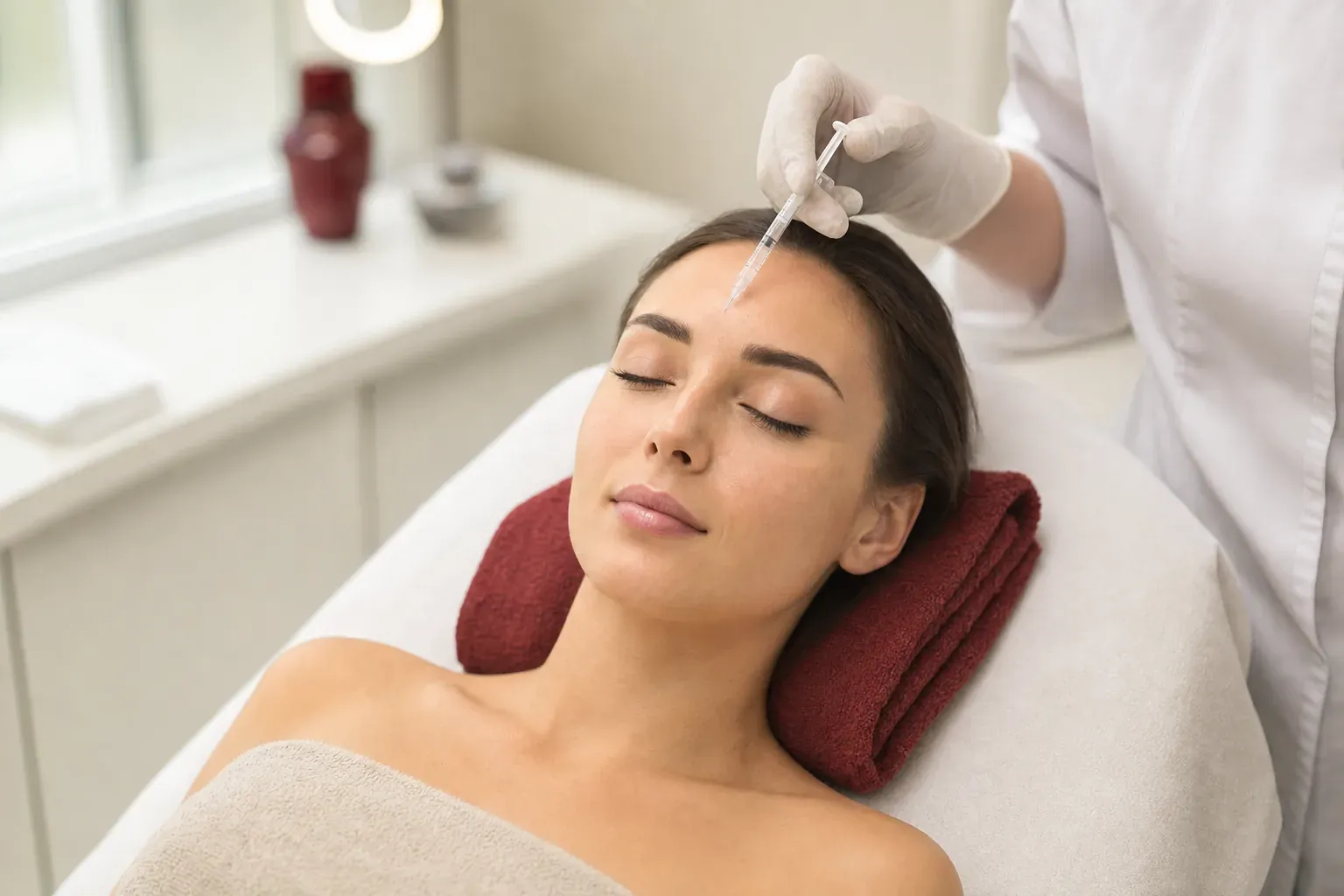
Expression lines: why they form on the forehead and between the brows and what to do
Expression lines form where the skin folds for years over the muscles we use to frown, raise our brows and smile: on the forehead, between the brows and around the eyes. At first, you only see them when you move your face, but with age and sun exposure, they stay visible at rest. Daily SPF slows this down, and botulinum toxin injections smooth existing expression lines; whether they suit you is something a cosmetic doctor decides after an examination.

Published Updated 5 min read

How expression lines differ from static wrinkles
Expression lines, also called dynamic wrinkles, appear when a muscle contracts and disappear as soon as your face relaxes. It’s easy to check: raise your brows in front of a mirror, then relax your forehead. The lines that appeared and disappeared are expression lines.
Static wrinkles are visible even when your face is at rest. Some of them used to be expression lines: the skin folds in the same place every day, recovers less well with age, and the line becomes fixed. Others form when tissues lose volume and the skin loses elasticity.
The type of wrinkle determines what to do about it. Expression lines are treated through the muscle, while a deep static fold usually needs to be filled.
Why lines form on the forehead, between the brows and around the eyes
Forehead lines form when you raise your brows, for example in surprise or out of habit while talking. The forehead muscle pulls the skin upward, and it gathers into horizontal lines.
Vertical lines between the brows appear when you frown, concentrate or squint in bright light. They can make you look stern or tired even when you’re in a good mood. If you often squint to read text or see the road, get your eyesight checked.
Crow’s feet at the corners of the eyes come from smiling and squinting. The skin around the eyes is thinner than on the rest of the face, so fine lines show up there early.
Besides facial movement, age and sun affect wrinkles. Over the years, skin loses elasticity and recovers more slowly. UV light damages the fibers that keep skin firm, so without sun protection, wrinkles deepen faster. Fine lines are more visible on dry or dehydrated skin, and smoking also speeds up skin aging.
How to care for your skin so lines form more slowly
Home care won’t relax a muscle, so it won’t remove a deep expression line that’s already there. It does slow the appearance of new lines and makes fine lines less visible.
- Apply SPF every day, all year round and even when it’s cloudy. In bright sun, wear sunglasses so you squint less.
- Moisturize with a cream that suits your skin type. During the heating season, indoor air is dry and skin dehydrates faster.
- Get enough sleep. After a few sleepless nights, your face looks more tired and lines are more noticeable.
What a cosmetic doctor can offer
At the consultation, a cosmetic doctor looks at your face at rest and while you make expressions, and assesses how deep the lines are and the condition of your skin. That determines which method will suit you.
Botulinum toxin injections smooth expression lines on the forehead, between the brows and around the eyes. The doctor injects small doses of botulinum toxin type A into the muscles, which then relax, so the skin above them creases less. Botulinum toxin doesn’t add volume, so it won’t fully smooth a deep static fold.
Deep static folds and lost volume are filled with dermal fillers. Among other things, hyaluronic acid fillers are used for deep lines on the forehead and between the brows, above the upper lip and around the mouth. You see the result right away and can fully judge it after a couple of days.
If your skin is dry and dull, has lost elasticity and has more fine lines, the doctor may suggest biorevitalization. These are hyaluronic acid injections that hydrate the skin from within. It’s usually done as a course of several treatments a few weeks apart.
Methods can be combined, for example botulinum toxin for the forehead with biorevitalization for the overall condition of the skin. The doctor decides the order of treatments and the break between them.
Who shouldn’t have injections for wrinkles
Botulinum toxin injections, dermal fillers and biorevitalization are done only by cosmetic doctors and only after a consultation. They aren’t done during pregnancy or breastfeeding, with an infection or inflammation of the skin in the injection area, or with an allergy to any component of the product. Each also has its own contraindications, such as myasthenia gravis for botulinum toxin or active herpes for fillers. The doctor checks the full list at the consultation.
After injections, slight swelling, redness or bruising can last a few days. Contact the doctor who did the procedure right away if severe pain develops after fillers or the skin in the injection area turns white, blue or blotchy, or if an eyelid droops after botulinum toxin. Call an ambulance on 103 if, after fillers, your vision suddenly gets worse, your eye hurts or you see double. Also call 103 if you have trouble swallowing, speaking or breathing, or your face, tongue or throat swells.
The consultation and treatments take place at the Viva Clinic aesthetic medicine center at 16b/3 Kuzovkova St in Slavuta. You can book by phone, on Viber or Telegram.
Questions and answers
At what age do expression lines appear?
There's no set age. Lines that only show when you move your face can appear in young people too, especially those with very expressive faces. With age, skin recovers more slowly and these lines gradually stay visible at rest, and sun exposure without SPF speeds this up.
How long do botulinum toxin injections for expression lines last?
Usually 3–4 months, longer for some people. Then the nerve endings recover, the muscle moves again and the lines gradually return. Injections can be repeated no more often than once every 3 months, and your doctor can tell you more precisely how long the effect may last for you.
Can the forehead, frown lines and crow's feet be treated in one visit?
Yes, several areas are usually treated in one session. A cosmetic doctor decides which areas you need and what dose to use after examining your facial movement. The first changes usually show after 2–3 days, and the full effect after about 2 weeks.